

NOTE: Images may not be exact; please check specifications.
-
Temporarily Out-of-Stock
- Call for next available delivery
Ordering Information
$858.15
Quick View
 Getting Details
- Ethernet 100Base-FXEthernet 100Base-TXEthernet 10Base-T Transceiver
- 100.0Mbps100Mbps Transfer Rate
- Fast Ethernet, Ethernet Protocol(s)
- FCC Class B certified, UL Compliant
The iConverter 10/100M2 conforms to the Ethernet in the First Mile (EFM) fiber standards to support Fiber-to-the-X Metropolitan and Enterprise LAN networks. The 10/100M2 provides intelligent, securely managed service demarcation at the customer premises, offering Layer 2 Control Protocol (L2CP) policy control, Quality of Service and enhanced Bandwidth Control (rate-limiting) capabilities. The 10/100M2 features built-in Operations, Administration and Maintenance (OAM) with comprehensive performance monitoring, fault detection and provisioning.
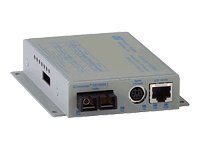
The 10/100M2 is available as a compact standalone unit or as a chassis plug-in module. The hot-swappable 10/100M2 plug-in modules can be mounted in a 19 or 5-Module chassis with any combination of redundant AC and DC power supplies. It can also be mounted in a 2-Module AC or DC powered chassis, or in a 1-Module chassis with AC or DC power input.
The plug-in module can manage other modules in the same chassis and operate as a managed 10/100 media converter. It features two Ethernet backplane ports for connectivity to adjacent modules in a chassis for multi-port and multi-service configurations.
The standalone 10/100M2 is available as a tabletop or wall-mount unit. The tabletop model can be DIN-rail mounted using an optional DIN-rail mounting kit. Both the tabletop and the wall-mount models are DC powered and are available with an external AC/DC power adapter or a terminal connector for DC power. The 10/100M2 standalone unit combines management capability with a compact chassis for deployment at the demarcation point.
The 10/100M2 features multiple, user-selectable link fault detection modes for quick fault detection and isolation. These modes operate independently of the network management and monitor the state of the cabling hardware.
Link-Segmentation (LS) - the normal (default) mode where the UTP and fiber ports establish their links to other connected devices independently of each other.
Link-Propagation (LP) - in this mode (also known as Link-Loss-Carry-Forward), a link-out from the UTP port is generated only when a link-in to the fiber port is present, and a link-out from the fiber port is generated only when a link-in to the UTP port is present. In LP mode, a cable or link fault is propagated in a domino fashion to downstream or upstream connected equipment, enabling rapid fault detection.
Asymmetrical Link Propagation (ALP) - ALP has two modes of operation: copper-to-fiber and fiber-to-copper. In the 'copper-to-fiber' mode, a fault on the UTP port will propagate across the fiber to attached link partner, but not to the UTP port of the link partner. A fault on the fiber will not propagate at all. In the 'fiber-to-copper' mode, a fault on the UTP port will not propagate through to the attached UTP device. In this mode the "domino" effect is limited.
Remote-Fault-Detection (RFD) - in RFD+LS mode, each port transmits a link signal only when receiving a link. As a result, link faults (no link received) are looped-back and can be reported to the network core.
Remote Fault Detection + Link Propagate (RFD+LP): In RFD+LP mode, link faults are propagated from the fiber to the UTP port and also looped-back to the fiber port. This mode provides rapid reporting of any cable faults to the network core.
Symmetrical-Fault-Detection (SFD) - SFD mode is similar to the RFD mode and provides a loop-back of a fiber link fault. When connecting two SFD configured converters back-to-back, this mode facilitates fiber or UTP fault notification to both ends of the network.
The 10/100M2 is available as a compact standalone unit or as a chassis plug-in module. The hot-swappable 10/100M2 plug-in modules can be mounted in a 19 or 5-Module chassis with any combination of redundant AC and DC power supplies. It can also be mounted in a 2-Module AC or DC powered chassis, or in a 1-Module chassis with AC or DC power input.
The plug-in module can manage other modules in the same chassis and operate as a managed 10/100 media converter. It features two Ethernet backplane ports for connectivity to adjacent modules in a chassis for multi-port and multi-service configurations.
The standalone 10/100M2 is available as a tabletop or wall-mount unit. The tabletop model can be DIN-rail mounted using an optional DIN-rail mounting kit. Both the tabletop and the wall-mount models are DC powered and are available with an external AC/DC power adapter or a terminal connector for DC power. The 10/100M2 standalone unit combines management capability with a compact chassis for deployment at the demarcation point.
The 10/100M2 features multiple, user-selectable link fault detection modes for quick fault detection and isolation. These modes operate independently of the network management and monitor the state of the cabling hardware.
Link-Segmentation (LS) - the normal (default) mode where the UTP and fiber ports establish their links to other connected devices independently of each other.
Link-Propagation (LP) - in this mode (also known as Link-Loss-Carry-Forward), a link-out from the UTP port is generated only when a link-in to the fiber port is present, and a link-out from the fiber port is generated only when a link-in to the UTP port is present. In LP mode, a cable or link fault is propagated in a domino fashion to downstream or upstream connected equipment, enabling rapid fault detection.
Asymmetrical Link Propagation (ALP) - ALP has two modes of operation: copper-to-fiber and fiber-to-copper. In the 'copper-to-fiber' mode, a fault on the UTP port will propagate across the fiber to attached link partner, but not to the UTP port of the link partner. A fault on the fiber will not propagate at all. In the 'fiber-to-copper' mode, a fault on the UTP port will not propagate through to the attached UTP device. In this mode the "domino" effect is limited.
Remote-Fault-Detection (RFD) - in RFD+LS mode, each port transmits a link signal only when receiving a link. As a result, link faults (no link received) are looped-back and can be reported to the network core.
Remote Fault Detection + Link Propagate (RFD+LP): In RFD+LP mode, link faults are propagated from the fiber to the UTP port and also looped-back to the fiber port. This mode provides rapid reporting of any cable faults to the network core.
Symmetrical-Fault-Detection (SFD) - SFD mode is similar to the RFD mode and provides a loop-back of a fiber link fault. When connecting two SFD configured converters back-to-back, this mode facilitates fiber or UTP fault notification to both ends of the network.
-
Cabling Type: Ethernet 100Base-FXCabling Type: Ethernet 100Base-TXCabling Type: Ethernet 10Base-TConnectivity Technology: WiredConnector: RJ-45
-
Form Factor: ExternalManufacturer Product Line: Omnitron iConverterModel: 10/100M2Weight Taxonomy: 16.01oz
-
Networking Type: Fiber media converter
-
Data Transfer Rate: 100Mbps
-
Networking Protocol: EthernetNetworking Protocol: Fast EthernetRemote Management Protocol: SNMPRemote Management Protocol: Telnet
-
This product is subject to our return policy. Please see our complete return policy for details.
-
2 lbs
-
Compliant Standards: FCC Class B certifiedCompliant Standards: UL
-
26121609
-
Warranty Period: Limited lifetime

| Description | Availability | Unit Price | ||
|---|---|---|---|---|
| View All Warranties | ||||
16